

Decorative Home Accessories: What to Buy and Why
Decorative home accessories are the finishing pieces that give a room its character: vases, bowls, trays, cushions, throws, frames and lighting that sit on top of the functional furniture.
Most rooms fail not because the furniture is wrong, but because the accessories are too small, too few, or bought one piece at a time with no plan.
Home Accessory Ideas by Room and Category
Home accessory ideas work best when you shop by category with a purpose, rather than browsing and hoping. The categories below cover the bulk of what most rooms need, followed by a simple sequence for placing them room by room.
Ornaments, Vases, Bowls and Trays
These are the workhorses of shelf and sideboard styling. A ceramic vase gives height, a shallow bowl adds a horizontal line, and a tray corrals small objects so they read as one arrangement instead of clutter.
Vary the finish, not just the colour: matte ceramic next to glass next to something metallic creates the tactile interest flat styling lacks.
Cushions, Throws and Textiles
Soft furnishings carry most of the warmth in a room. The practical rule: two cushions on a two-seater, three on a three-seater, and one large throw folded over an arm rather than spread flat.
Mix textures rather than piling on patterns: a chunky knit, a smooth linen and a velvet piece look intentional, while four different prints look like a clearance shelf.
Wall Art, Frames and Mirrors
Hang art so the centre sits at roughly eye level, usually 145-155 cm from the floor, and leave 15-25 cm between the top of a sofa back and the bottom of the frame. Mirrors bounce light and make a small room feel less boxy, so place one opposite or adjacent to the main light source rather than on a dark wall.
Lighting and Candle Holders
Decorative lighting is layered lighting: a table lamp, a floor lamp and a candle or two give three pools of light at different heights, far more flattering in the evening than one overhead fitting. Choose a shade comfortably wider than the base; a narrower shade makes even an expensive lamp look top-heavy.
Rugs and Runners
A rug should be large enough that at least the front legs of the main seating sit on it; one that floats with a gap around the sofa makes the room feel smaller, not larger. Runners work in hallways and beside beds, where a full rug would be impractical.
Shelving and Display Pieces
Freestanding shelving, slim console tables and picture ledges do the work of built-in joinery without the cost or fixings. A console table behind a sofa or in a hallway gives you a surface for a lamp, a tray and one object, often all a space needs.
Storage and Organisation
Decorative storage is the compromise between hiding everything and displaying everything. Baskets, lidded boxes and fabric bins absorb the small, ugly items, remotes, cables, chargers, so the visible accessories are the ones you actually want to look at. One basket per shelf run is usually enough.
A Simple Room-by-Room Sequence
Most practitioners find it helps to work in the same order in every room:
- Living room: start with the largest piece (sofa or sideboard), add a rug that grounds the seating, then layer textiles, then one anchor ornament or lamp, then small objects and frames last.
- Bedroom: bed first, then bedside tables (one lamp and one small object each), then a throw and two cushions, then art above the headboard.
- Hallway: a runner or small rug, a console or shelf, a mirror, and a tray for keys. Keep it to four elements so it does not become a dumping ground.
- Dining area: a centrepiece that is low enough to see over, a runner or tablecloth, and wall art or a mirror on the largest blank wall.
Decorative Accessories for Living Room Schemes
Decorative accessories for living room schemes should follow the lines of the furniture, not fight them.
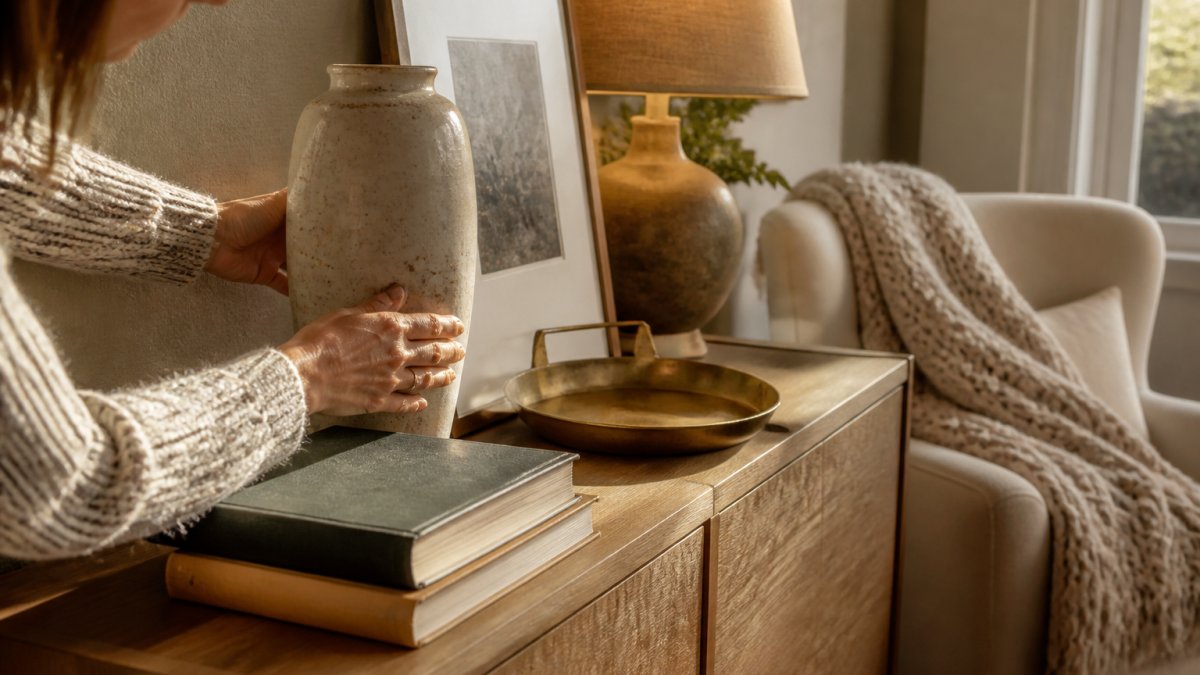
Start with the largest item in the room: against a big sofa, small trinkets disappear. Buy fewer, bigger pieces and let them breathe.
A common mistake is treating the coffee table as a display cabinet. One tray, one stack of two or three books, and one object on top is the whole formula.
Shelf Styling Ideas That Look Considered
Shelf styling ideas succeed or fail on rhythm. Alternate between groups of books, single sculptural objects and empty space, empty space is a design element, not wasted shelf.
Follow this sequence across a run of shelves:
- Start each shelf with a vertical anchor: a row of books or one tall vase
- Add one horizontal element: a stacked pair of books or a shallow bowl
- Place one small object on top of the horizontal stack
- Leave roughly a third of each shelf empty
Books should be real ones you would read. Filler books bought by the metre look exactly like filler books bought by the metre.
Sugarplum Bakery Advent Calendar →
Decorating a Rented Home Without Fixings
Decorating a rented home without fixings starts with leaning rather than hanging: frames can rest on a sideboard or picture ledge, mirrors can lean against a wall, and lighting can be plug-in rather than wired.
Freestanding shelving, slim console tables and tall plants do the work built-in joinery would in an owned home. Adhesive hooks, used within their stated weight limits, handle lightweight frames and small ornaments, but always check your tenancy agreement before fixing anything to a wall.
Renting also rewards pieces that move well: textiles, trays, vases and ornaments pack into a couple of boxes and suit any future room, a better use of money than anything fitted.
Scale, Proportion and Visual Balance
Scale is the most common failure point in home styling, and the easiest to fix. An accessory should be either clearly larger or clearly smaller than what sits beside it, never nearly the same size, near-matches read as an accident.
Visual balance does not mean symmetry: a heavy object on one end of a sideboard can be balanced by a lighter, taller object at the other, or by wall art hung off-centre above it.
| Problem | Fix | Why It Works |
|---|---|---|
| Accessories look lost | Buy fewer, larger pieces | Gives the eye one focal point |
| Shelf looks cluttered | Remove a third of the items | Restores negative space |
| Arrangement feels flat | Mix matte, glass and metal | Adds tactile contrast |
| Room feels unbalanced | Pair heavy with tall and light | Spreads visual weight |
| Coffee table unusable | One tray, one book stack | Frees surface area |
Materials, Care and What Lasts
What lasts comes down to material honesty. Glazed ceramic, glass, solid wood, marble and quality metals hold up for years; thin resin and painted finishes chip and fade.
Textiles are the exception worth spending on: a wool or cotton throw outlasts a synthetic one several times over and looks better as it ages.
For seasonal pieces, reusable beats disposable.
Budget Tiers and Cost-Conscious Styling
Cost-conscious styling works by concentrating spend where it shows. Here is a practical framework with price bands in pounds.
Three Budget Tiers
- Under £50 per room: textiles and trays give the biggest visible change per pound. A pair of cushion covers, a cotton throw, a shallow tray and a small vase will refresh a sofa or sideboard for well under £50 if you shop carefully.
- £50-£150 per room: one good ceramic, glass or metal piece anchors a whole shelf, and the rest of the budget goes on textiles and frames. This is the tier where a single well-chosen lamp or mirror starts to carry the room.
- Over £150 per room: spend on pieces you will keep for a decade, a solid marble board, a well-made mirror, a lamp with a proper shade. These are the items where material quality is visible and where cheap versions age badly.
A Sensible Split
A common pattern for a single room is roughly half the accessory budget on textiles, a quarter on one anchor piece, and the rest on small objects and frames, a finished look without any single purchase feeling risky.
What to Buy First
If you can only buy three things, buy in this order:
- A textile, a throw or cushion covers, because they soften hard edges and are the cheapest way to change a room's mood.
- A tray, it turns a scatter of small objects into one arrangement and costs very little.
- One anchor piece, a vase, lamp or mirror that gives the eye somewhere to land.
Frames, small ornaments and seasonal pieces come last, once the bones of the arrangement are in place.
Cost-Conscious Habits
- Buy one piece you genuinely want and build around it, rather than filling a basket with safe, small items. The curated route costs the same and looks considerably better.
- Reuse what you already own: books, bowls and candlesticks from other rooms count as accessories.
- Buy textiles in neutral colours so they work in any future room, and spend the colour budget on one or two small pieces you can change seasonally.
- Check the material before the price. Thin resin and painted finishes chip and fade, so a cheap piece that lasts two years is worse value than a mid-priced one that lasts ten.
For seasonal pieces, reusable beats disposable. A resin advent calendar such as the Sugarplum Bakery Advent Calendar at £24.99 is designed to be displayed year after year on a shelf or mantelpiece, which is a different proposition from a cardboard calendar that goes in the bin on the 25th.
Frequently Asked Questions
How many decorative accessories should I use in one room?
Work in odd-numbered groups of three or five and leave empty space between them. A sideboard might hold one large vase, a stack of two books and a small bowl. Stop adding when every surface is full; negative space is what makes decorative home accessories read as considered rather than cluttered. If a surface has more than five objects, remove the weakest one and see if the arrangement improves.
How can I decorate a rented home without making permanent changes?
Choose pieces that stand on surfaces or hang without drilling. Freestanding shelving, leaning mirrors, over-door hooks, removable adhesive strips and cordless lamps all work in a rental. Rugs and runners cover tired flooring without touching it, and curtains on tension rods avoid new fixings. Keep the deposit in mind: anything that marks paint or tile is a risk, so favour freestanding decorative accessories you can take with you when you move.
How do I make a room feel cosy with accessories?
Layer texture rather than adding more objects. A throw over the sofa arm, a rug under the coffee table, cushions in two or three tactile fabrics and a warm-toned lamp do more for comfort than another ornament. Group lighting at two or three heights, keep the brightest light off the ceiling, and use trays to gather small items so surfaces stay calm. Colour also matters: deeper, warmer tones on textiles make a room feel enclosed and restful.
What should I check before buying decorative home accessories online?
Look for real customer photos, not just studio shots, and check the listed dimensions against your surface before ordering. Confirm the material and care instructions, especially for marble, ceramics and textiles, and read the returns policy so you know your options if a finish fails. Ask whether colours are photographed under daylight. A retailer that shows scale in context and states delivery and free returns terms clearly is easier to buy from with confidence.
The hardest part of accessorising is not finding pieces you like; it is knowing when to stop and what to leave out. Antique and Modern curates home decor and seasonal items that blend classic elegance with contemporary style, from decorative vases and kitchenware to festive pieces designed to be reused year after year. Browse the collection, start with one anchor piece, and build the room around it.