

What Makes a Christmas Tree Ornament Worth Buying
Good christmas tree ornaments earn their place by surviving more than one season, holding their colour, and looking right from arm's length rather than just in a product photo. Unique Christmas tree ornaments are not the same as expensive ones.
Below, we break down what separates a keeper from a one-December wonder, how to buy unusual decorations online without disappointment, and how to hang heavier pieces without wrecking your branches.
Materials That Last More Than One Season
Glass, brass, and dense porcelain hold their finish for years. Thin plastic and painted resin chip, dull, and cloud within a season or two.
Weight is the giveaway. A glass or metal bauble has a satisfying heft; a hollow plastic one feels light and rattles slightly when shaken. Check the cap and hanging loop too. A flimsy wire loop will bend under a heavy ornament, and a glued cap can pull free when the piece swings.
How to Judge Colour and Finish Online
Screens lie about colour. Warm-toned product lighting makes reds look richer and metallics look brighter than they arrive.
Look for listings that show the same piece under more than one light source, ideally a daylight shot alongside a styled room shot. If every photo has the same golden glow, assume the real colour is cooler and more muted. Read the finish description carefully: "brushed", "matte", "mirror" and "antique" all behave differently on a tree, and a mirror finish will reflect your fairy lights rather than sit quietly among them.
Unusual Christmas Tree Decorations That Start Conversations
The best unusual Christmas tree decorations give guests a reason to lean in and ask where you found it. A lobster in a Santa hat, a tiny brass trumpet, a ceramic chip shop chip: these pieces work because they are specific, not just strange.
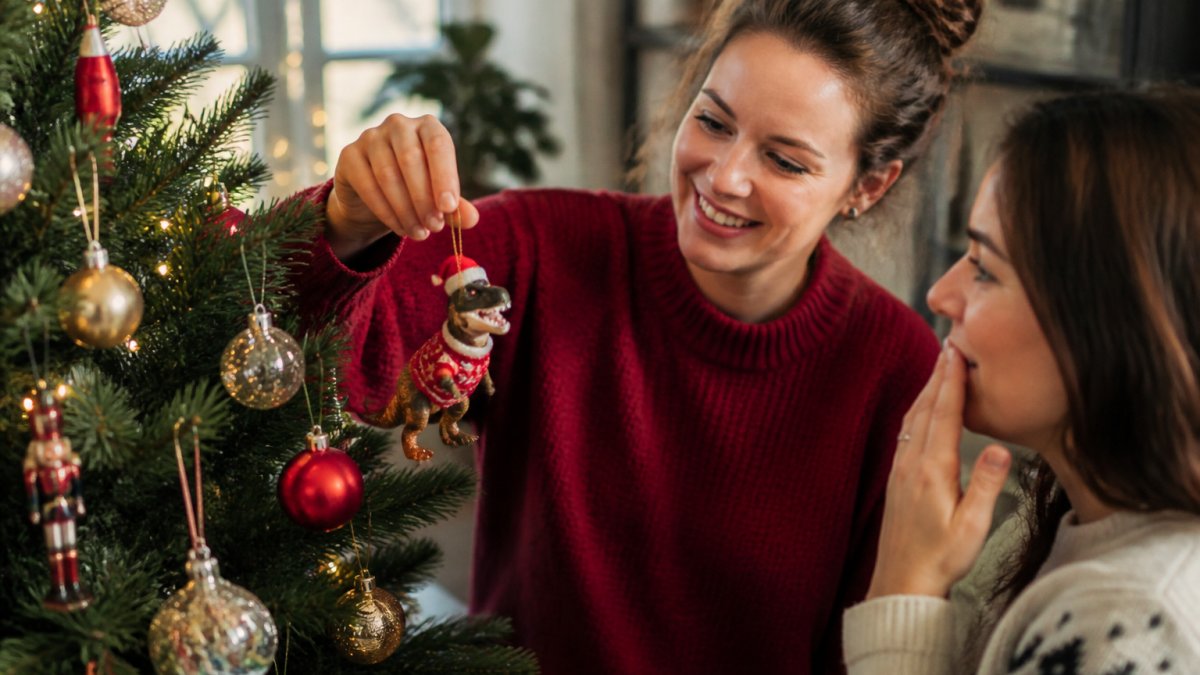
Start with one or two statement pieces per tree and let the rest recede. A tree covered entirely in novelties reads as clutter; a tree with three deliberate oddities reads as personality. Novelty baubles, kitsch decorations, and character pieces all fall into this category, and they mix best with plain glass in a matching palette.
Handmade Christmas Ornaments: What to Look For
Handmade Christmas ornaments are worth buying when the making shows: visible stitching, slight variation between pieces, a signature or date on the base. Those imperfections are the proof of handwork. But "handmade" covers a wide range of craft, cost and durability, so it helps to know what you are actually buying before you commit.
The Main Handmade Categories and What They Cost
- Felt and wool, cut-and-sewn or needle-felted pieces, often with embroidery. Wool felt holds colour well and resists pilling; cheap synthetic felt looks fuzzy and sheds fibres. Check that the filling is not loose wadding that will clump.
- Fabric and cotton, quilted, appliquéd or stuffed shapes. Look for French seams or overlocked edges, because raw edges fray after a season or two.
- Crochet and knitted, cotton or wool yarn over a stiffened core. Cotton crochet holds its shape better than acrylic, which stretches and bobbles.
- Paper and card, folded, quilled or layered pieces. Paper is the most fragile category and the least suited to damp rooms or homes with curious pets.
- Wood and laser-cut, plywood or hardwood shapes, often painted. Check the thickness: 3 mm ply warps; 6 mm and above stays flat.
How to Tell Real Handwork from Machine Repetition
Be wary of pieces marketed as handmade that show machine-perfect repetition. True handmade decorations vary slightly from one to the next, a stitch length here, a paint edge there. Ask what the piece is made from and how it should be stored, because wool felt, cotton fabric, and recycled paper all need different care. Paper ornaments in particular should be kept away from damp and direct heat.
A few practical checks:
- Turn the piece over. Hand-finished ornaments usually have a neat reverse; mass-produced ones often show glued-on loops or heat-sealed edges.
- Look at the hanging loop. A hand-tied ribbon or waxed cord is a good sign; a moulded plastic loop is not.
- Ask whether the maker signs or dates the base. Many do, and it helps if you later want to trace or repair the piece.
The Sustainability Angle Competitors Miss
Handmade and recycled often overlap, and this is where a handmade ornament earns more than good looks. Look for pieces made from offcuts, reclaimed fabric, recycled paper or repurposed buttons and beads. These keep materials in use and usually cost no more than new-material equivalents.
A few things to check if low waste matters to you:
- Packaging, paper tape and card over plastic film and polystyrene.
- Repairability, a stitched piece can be re-sewn; a glued one often cannot.
- Material honesty, a maker who names the fibre and the source is easier to trust than one who says only "eco-friendly".
Handmade ornaments also tend to be the easiest to repair, which stretches their life well beyond the one-season pieces.
Vintage Christmas Tree Decorations: Buying and Mixing
Vintage Christmas tree decorations bring a patina you cannot manufacture, but condition matters more than age. Check for cracks, missing paint, and tarnished caps before you commit.
Mixing vintage with new works when you anchor both to a shared palette. Pull two or three colours from the vintage pieces, say faded red, cream, and aged gold, then choose new ornaments in those same tones.
Christmas Tree Decorating Ideas for a Cohesive Look
Cohesion comes from repetition, not from matching sets. Pick a palette of two to three colours and a single metallic accent, then repeat those across every layer of the tree.
Work in this order:
- Hang lights first, close to the trunk, so they glow through the branches
- Place larger statement ornaments in the gaps and lower branches
- Fill the middle with medium baubles in your palette
- Finish with small pieces and any personal or sentimental ornaments at eye level
For anyone renting or short on space, a tabletop tree or a hanging branch display carries the same ideas without permanent fixtures. Our seasonal collection is built around pieces that store flat and hang light.
Personalised and Custom-Made Ornaments
Personalised ornaments turn a decoration into a keepsake. Names, dates, and small messages work best when engraved or embroidered rather than printed, because print fades and engraving does not. But personalisation is where most buyers get caught out, so it is worth understanding the options, the lead times and the costs before you order.
The Main Personalisation Methods
- Engraving, laser or hand engraving into wood, glass, metal or slate. The most durable option and the best choice for a piece you intend to keep for decades.
- Embroidery, stitched names and dates on felt or fabric. Warm and tactile, but slower to produce.
- Printing, UV printing or transfer onto ceramic, glass or wood. Cheapest and fastest, but the least durable; print can fade or lift with handling.
- Hand-painting, lettering painted directly onto the piece. Charming but variable; ask to see previous work.
Lead Times and Deadlines
Order custom pieces early. Hand-finished personalisation takes time, and the closer you get to December the tighter the turnaround. As a working guide:
Most makers cannot amend a personalised piece once it is finished, so confirm the exact spelling, font and layout before it goes to production. Check names with unusual spellings letter by letter, and decide whether you want the year included, some people prefer a date, others find it dates the piece.
Matching the Ornament to the Recipient
Personalisation works best when it is aimed at a specific person or occasion. A few pairings that tend to land well:
- A first Christmas in a new home, a engraved house shape or a key with the address or year.
- A couple's first Christmas together, a two-name piece, often a heart or a pair of figures.
- A new baby or first Christmas, a name and date on a soft felt or wooden piece, kept away from the tree's lower branches.
- A collector, a dated piece in a series, or a maker's signature piece, rather than a name.
- A grandparent, a piece listing grandchildren's names, which works better on a larger flat shape than a bauble.
A custom ornament also makes a strong gift for a housewarming or a first Christmas in a new home, and because it is made to order it sidesteps the problem of buying someone a decoration they already own.
How to Hang Unusual Ornaments Securely
Heavy or oddly shaped ornaments need more than a bent wire hook. Use a proper metal hook or a fabric ribbon loop rated for the weight, and hang heavy pieces on the stronger inner branches close to the trunk.
For awkward shapes, thread the loop through the hanging point and tie off rather than relying on a clip. Distribute weight evenly around the tree so it does not lean, and check the hanging points again after a week, since branches settle under load.
Frequently Asked Questions
What are some unusual Christmas ornaments I can buy?
Look for food and drink-themed pieces, animal figures, hobby-themed ornaments such as musical instruments or transport shapes, and pop-culture characters. Novelty baubles in unexpected shapes stand out against standard round decorations. Check the material and finish before buying: glass and brass hold colour well, while painted wood can chip. Personalised pieces add another layer of difference.
How can I mix vintage and modern Christmas decorations on one tree?
Pick a shared colour palette first, then mix eras within it. Put vintage glass or brass pieces near modern matte baubles so the contrast reads as intentional. Keep the oldest or most fragile ornaments higher up and toward the back, where they are less likely to be knocked. Repeat shapes two or three times across the tree to tie the mix together. A tree that combines vintage Christmas tree decorations with contemporary pieces looks collected rather than cluttered when the colours agree.
How do I keep heavy or unusual ornaments secure on the tree?
Hang heavier pieces on lower, sturdier branches and use a wire hook rather than a loop of thread. Bend the hook closed around the branch so it cannot slide off. For very heavy ornaments, tie a second loop of ribbon around the branch as support. Keep glass and fragile pieces away from walkways and pets. If you have children or a cat, place delicate ornaments in the top third of the tree and secure the tree itself to a wall fixing.
Are handmade Christmas ornaments worth the extra cost?
Handmade pieces usually cost more because of the labour involved, but they tend to be more distinctive and often more durable when made from felt, wool, brass or kiln-fired clay. Check the stitching, the weight of the hanging loop and whether the colours are dyed or painted. Ask the seller how to clean the piece. Handmade Christmas ornaments also work well as gifts because no two are identical, which matters if you want a tree that does not look like a showroom display.
Choosing ornaments is really a test of patience. The pieces worth keeping are the ones you would still hang if no one else ever saw them. At Antique and Modern, our curated selection blends antique character with modern restraint, so a tree can carry both without looking like a jumble. Browse our seasonal collection to find pieces that store well, hang light, and last beyond a single December.