

Why Vintage Glass Baubles Still Outshine Modern Decorations
Vintage glass Christmas baubles are hand-finished ornaments made from blown or moulded glass, usually with a silvered interior and a metal cap, and these vintage glass Christmas baubles bring a depth of colour and reflection that plastic simply cannot match.
There is a practical reason for that. Glass is heavier and denser, so each bauble hangs with a slight, satisfying weight that keeps it steady on the branch.
Nostalgia plays a part too. Many households inherited a box of decorations from parents or grandparents, and those pieces carry the memory of Christmases past.
Below, we explain how to spot genuine antique pieces, how to grade condition, and what to ask before you buy.
Antique Christmas Ornaments: How to Spot the Real Thing
Antique Christmas ornaments are decorations made before the mid-twentieth century, and the fastest way to tell a genuine piece from a modern reproduction is to look at the cap, the paint and the glass seam. Modern copies are often convincing at a distance, so examine each one closely.
Checking the Cap, Paint and Glass Seam
Start with the metal cap at the top. Older caps are usually thin, dull and slightly uneven, often with a faint maker's mark or a patent number stamped into the metal.
Next, turn the bauble in your hand and look at the paint. Hand-painted decoration sits slightly raised, with small brush marks and tiny variations in thickness. Printed decoration is perfectly even and often has a visible dot pattern under a magnifier.
Finally, find the seam. Genuine moulded glass usually shows a faint line where the two halves of the mould met. A seam that is razor-sharp and perfectly straight is a warning sign; old moulds left a softer, slightly wavy line.
Mercury Glass Christmas Ornaments and the Silvered Finish
Mercury glass Christmas ornaments are glass baubles with a silvered coating applied inside the glass, which gives them a mirror-like shine and a soft, slightly cloudy glow. The name comes from the old technique of lining glass with a silver solution, not from real mercury.
That silvered layer is what separates a good bauble from a dull one. When light hits the outside, it passes through the coloured glass, bounces off the silver lining and comes back out.
Age changes the finish. Genuine mercury glass from the mid-century often shows small patches where the silvering has thinned, and collectors generally accept this as part of the character.
Glass Christmas Baubles vs Plastic: What Actually Differs
The difference between glass Christmas baubles vs plastic comes down to weight, light and lifespan. Glass is denser, reflects light through a silvered lining, and can last for decades if stored well. Plastic is lighter, cheaper to produce and far more likely to scratch or fade.
| Feature | Glass baubles | Plastic baubles |
|---|---|---|
| Weight on the branch | Heavier, hangs steady | Light, can swing |
| Light reflection | Layered, from silvered lining | Flat, surface only |
| Finish over time | Silvering may cloud with age | Paint scratches and fades |
| Repair options | Limited, handle with care | Often replaced, not repaired |
| Best for | Display trees, heirloom collections | High-traffic trees, homes with pets |
Neither is automatically better. A household with young children or curious pets may prefer plastic on the main tree and keep glass on a smaller display tree in a quieter room. Glass rewards careful handling with a look that holds up year after year.
Vintage Christmas Tree Decorations: Shapes, Colours and Sets
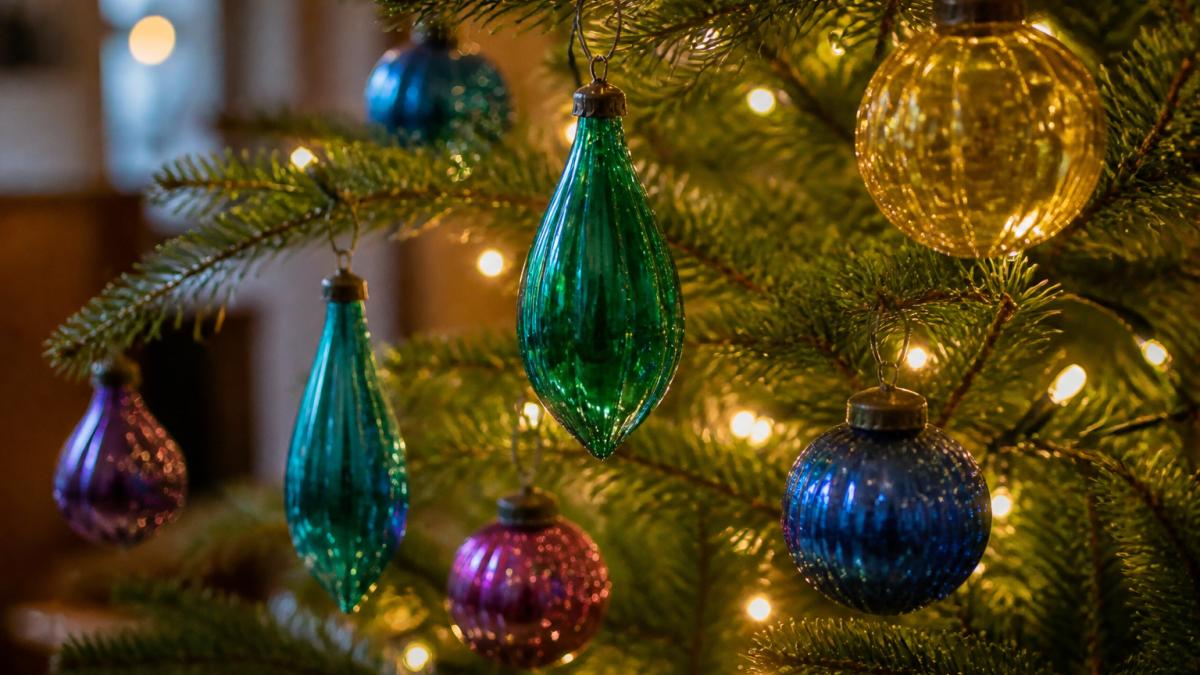
Vintage Christmas tree decorations fall into a handful of recognisable shapes and colour families, and buying within those families is the easiest way to build a tree that looks collected rather than random. The classic palette runs through green, yellow, blue and purple, often with a metallic finish that catches the lights.
Globes, Teardrops and Dimpled Finishes
Globes are the standard round bauble and the easiest to mix across a tree. Teardrops hang lower and add movement, especially on the outer branches where they can turn freely. Readers drawn to classic festive foliage can also browse a glass mistletoe bauble. For traditional motifs, glass holly baubles bring classic festive foliage to the tree.
A useful rule of thumb is to work in odd numbers and vary the scale. To complement glass baubles, hanging stars help finish a coordinated vintage tree. Hang larger pieces (around 5.5 cm) on the lower and inner branches where they have room, and smaller pieces (around 3 cm) towards the top and outer tips.
Building a Coordinated Palette
Rather than buying a single matched set, most collectors build a palette over several seasons. Start with a base colour that suits your tree, deep green or midnight blue for a traditional look, or a softer silver and pale gold for a lighter scheme, then add one or two accent colours in the same metallic finish. Keeping the finish consistent (all silvered, all matte, or all glittered) is what makes a mixed collection look intentional rather than haphazard.
Condition Grading, Safe Handling and Storage
Condition grading is the part most buyers skip, and it is where money gets lost. A simple three-tier system keeps you honest: display grade, shelf grade and craft grade.
- Display grade: full silvering, intact paint, no chips, cap secure. Goes straight on the tree.
- Shelf grade: minor silvering loss or light paint wear, structurally sound. Fine for a secondary tree.
- Craft grade: chips, heavy flaking or a loose cap. Buy only for craft projects, never for display.
Handle glass baubles by the body, not the cap, and wear thin cotton gloves to avoid leaving oils on the paint. Store each piece wrapped in acid-free tissue inside a divided box, and keep the box somewhere dry and away from loft temperature swings.
What to Pay and What to Ask Before You Buy
Pricing for vintage glass baubles depends on age, condition, rarity of shape and whether the piece still has its original box. Because values shift with demand, check current listings for the pieces you are considering. What we can do is explain how the market is structured, so you know what drives a price up or down before you commit.
How Value Is Built
A single mid-century glass bauble in display grade typically sells for a few pounds to around £15, while rarer shapes, unusual colours or pieces with their original branded box can reach £30-£60 or more. Full sets of six or twelve in a original box command a premium because they are harder to find intact.
Be wary of any listing that describes a piece as "rare" without explaining why. Rarity in vintage glass usually means a shape or colour that was produced for a short run, not simply an old bauble. Ask the seller what makes it rare, and expect a specific answer.
Questions That Reveal a Good Seller
Before you commit, ask the seller these questions:
- Is the cap original, and is it stamped?
- Are there chips around the opening or the base?
- How much silvering loss is visible inside?
- Has the piece been repainted or touched up?
- Does it come with its original box or packaging?
- Can you send a photo of the seam and the cap close up?
A seller who answers these clearly is usually a seller worth buying from. Vague answers about condition are the most common warning sign. Ask for dimensions in centimetres rather than relying on photos, because scale is hard to judge on screen, and confirm that the piece will be sent wrapped in bubble wrap and a rigid box, glass baubles rarely survive a padded envelope.
For broader context on how glass ornaments are made and cared for, the Victoria and Albert Museum's collection of glass is a useful reference, and the Glass Alliance Europe's guide to glass recycling and reuse explains why glass pieces last so long when handled well.
Frequently Asked Questions
How can you tell if a Christmas ornament is real mercury glass?
Real mercury glass has a double-walled construction: a silvered coating sits inside the glass, not painted on the outside. Hold the bauble up to light and the shine appears to come from within. Genuine pieces feel heavier than they look and often show small areas of silvering loss around the cap. Reproduction mercury glass usually has a sprayed metallic finish on the outer surface, which scratches off with a fingernail. Check the cap too, as older ornaments often use crimped metal caps rather than glued-on fittings.
Are vintage glass Christmas baubles fragile?
Yes, they are genuinely fragile. Thin-blown glass from the 1950s to 1970s cracks under light pressure, and the paint or glitter coating flakes if knocked. Handle them by the cap rather than the body, hang them on sturdier inner branches and keep them away from walkways and pets. Store each bauble wrapped individually in acid-free tissue inside a divided box, and never stack boxes on top of each other. Treat them as display pieces rather than everyday decorations.
What makes a glass Christmas bauble vintage rather than vintage-style?
A true vintage bauble was made decades ago, typically between the 1950s and 1970s, and shows honest signs of age: slight paint wear, a tarnished cap, a hand-painted finish with small irregularities. Vintage-style baubles are new pieces made to look old, often with deliberate distressing and modern materials. Ask the seller for the age, origin and any maker's marks. European glass baubles from that era often carry a small label or a distinctive cap shape that helps confirm the period.
How should you care for and store vintage glass baubles?
Wrap each bauble loosely in acid-free tissue and place it in a rigid, divided storage box so pieces cannot touch. Keep the box somewhere dry and away from temperature swings, such as a loft or cupboard rather than a damp garage. Never hang baubles by the cap for long periods, as the wire can stress the glass. Dust with a soft brush rather than a damp cloth, which can lift paint. Inspect pieces each season and retire any with hairline cracks before they break on the tree.
Building a tree that feels collected rather than bought in one go takes time, and the pieces that last are the ones chosen with condition and shape in mind. At Antique and Modern, our seasonal collection brings together glass baubles and hanging decorations that blend vintage charm with a clean, modern finish, so you can add a few pieces each year. Browse the collection to add a glass pearl and gem bauble, holly and mistletoe designs, or a set of hanging stars to your tree.